
Portage Indiana Concrete Sidewalks – Raised Joints
A ground-down lip on a sidewalk looks fine for a month. Then the same joint sits high again, and the grind mark is still there. We’ve pulled up panels in Portage where someone feathered asphalt over the step, and the patch had broken into chunks that held water. A thin cap over a tipped square fails the same way, because the slab under it keeps moving. People patch Concrete Sidewalks in Portage like that in older yards, and the patch doesn’t stay put.
After the ground thaws, the high edge is easy to see. One square sits above the next at the joint. But sometimes the whole panel rocks when you step near the low corner. So people have called us about the front walk, and about the service walk that runs along the side of the house.
That raised edge catches a shoe and a stroller wheel. Families around here use the front walk to reach the curb and the driveway. So the joint changes the walking surface. It stays high until we cut those squares out.
Concrete Sidewalks in Portage After a Hard Freeze
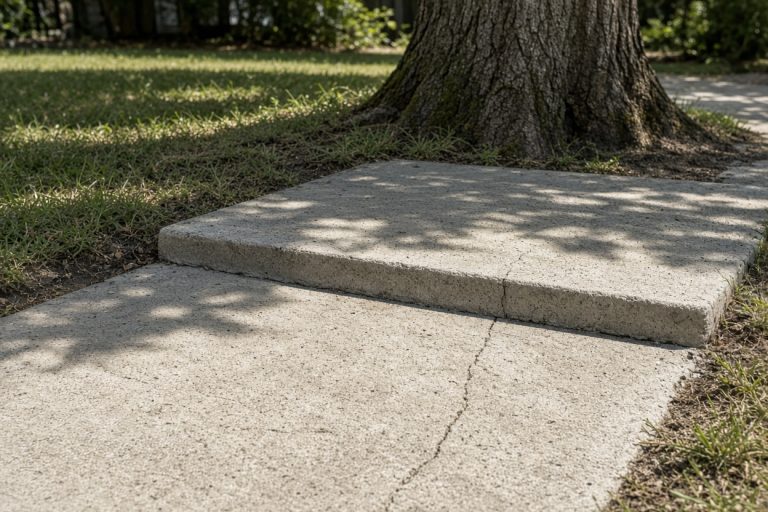
Water sits in the joint and in the soil under the edge. When that water freezes, it expands and can push the panel up. After the thaw, the soil may not settle back even, so the square stays high on one side. We’ve seen walks sit flat in the fall and sit high at one joint by spring.
Tree roots lift panels from below as they thicken. In older Portage neighborhoods the shade trees are large enough to run under a walk. Because a root keeps growing, the panel tips and the joint opens. We’ve opened runs and found a root and a frost lift under the same squares. For example, the root had raised one corner, and water had then frozen under that edge.
Portage sits close to Lake Michigan, so winter here brings a freeze and a thaw, and then it freezes again. So the panels can heave through those repeats. A single cold week may leave the walk looking the same as it did in November. But we don’t name the cause from the street. When we are on the walk, we check under the edge before we mark the cut.
Get A FREE Proposal Today!
Those raised joints are the flatwork we get hired to cut out and replace. On walks we have replaced, someone had already ground the lip, and the lip had come back. When Concrete Sidewalks in Portage sit like that, the bad squares come out, and the new pour has to meet the panels we leave.
How We Replace Concrete Sidewalks in Portage
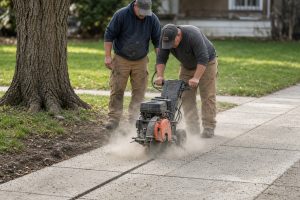
We saw the concrete back to a sound edge. Then we break out the tipped panels and haul them off as concrete removal. The pour that follows is a tear out and replace. After we clear the hole, we check the base. Soft spots and root wood come out. We compact the soil that stays, and we set forms to the height of the remaining walk.
The same visit can take a service walk if that run is tipped too. Residential concrete of this size is regular work for our crew. After the pour, we broom the finish so wet shoes get some grip. And we tool the joints so water can run out of the joint. Concrete Sidewalks in Portage that we pour back get that joint layout before we strip the forms.
Cabe’s Concrete is a family owned and operated company, and we have done this flatwork in northwest Indiana since 2006. Because our staff has spent years on removal and pour-back, the sequence is familiar. You can see who we are on the About Us page. We also cover a wider Cabe’s Concrete service area around Portage.
We pour the new squares level with the walk we kept. When the forms come off, a stroller can cross that joint without a catch at the edge. We’ve checked old jobs and found an even joint where we cleaned the base. That cut-out and pour-back is part of our concrete sidewalk replacement.
We tell you, before we leave, when the new concrete can take foot traffic. When the walk meets broken curb, we have taken that short run out on the same visit. On Concrete Sidewalks in Portage, we strip the forms and rake the lawn edge back to the grade we found.