
St. John Indiana Concrete Overlays for Old Drives
You step out and the tire paths look rough under your shoes. The broom finish is gone there, and small stone shows where the paste wore off. A few flakes sit by the garage, where winter salt water drips off the car. In the older neighborhoods of St. John, Indiana, that kind of surface wear is what people call us about. When the slab under it still feels solid, Concrete Overlays in St. John are what people ask about.
So the first thing we do is walk the whole drive, edges included. We look at the joints and at the strip where the apron meets the street. After a hard winter in northwest Indiana, salt and freeze-thaw leave the top layer thin in the wheel tracks. The rest of the slab can still be tight. We’ve tapped panels that sounded solid under a surface that looked worn out.
Established streets in St. John, Indiana carry the same cars every day. People leave for work toward the rest of Lake County and come home after dark. Traffic and a shovel at the apron wear the top long before the base gives. Because those homes have sat for years, the original pour under the wear often still holds. We’ve seen drives on those blocks with a rough face and a base that still holds.
Concrete Overlays in St. John on Driveways That Still Hold
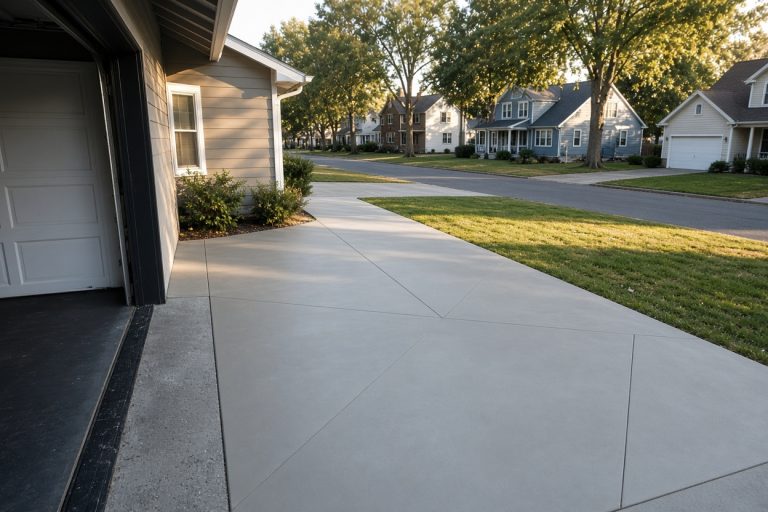
When owners call, they usually want to know if we can top the drive. A full tear-out is the other path, and they ask about it second. Then we start by checking whether the panel moves. A slab that rocks, or one that has heaved at a joint, is a poor candidate for a topping. So is a section where the base has washed out along the edge. For example, we talk about concrete removal and a tear-out and replace.
But a drive that is worn on top and firm underfoot is a different job. We’ve walked St. John, Indiana drives that showed scale on top while the panel still sat flat. We can fill tight cracks and cover them. Cracks that open and close with the seasons need a harder look before any topping goes down. Then we decide if an overlay can bond to what is there.
Concrete Overlays in St. John work as a bonded layer over that sound concrete. We clean off the scale and cut out anything loose. After that, we set a bond so the new layer grabs the old slab. The mix we use depends on how deep the wear goes and on the look you want. Because we specialize in overlays and colored concrete, the topping can stay plain gray or take a stamp. We source products we know are the best available, and we talk through the look before we pour.
Get A FREE Proposal Today!
What We Check Before Concrete Overlays in St. John
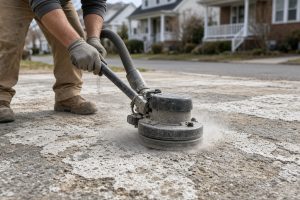
Before we say a topping will work, we look at how water leaves the slab. Water that sits in a low spot will sit on a new layer too. So we note any birdbath and the slope toward the street. Then we check whether the garage floor sits lower than the drive. But a thin overlay leaves a drainage problem in place. When the grade is wrong, we may cut and pour back a section.
After we check the drive, we look at the walks that meet it. A worn service walk can get the same visit. An upper walk can get that visit too, if it’s sound enough to top or if it needs replacement. Curb appeal work often includes that front walk and the apron on older St. John, Indiana lots. Concrete Overlays in St. John can cover a sound walk on the same visit. We will work with you on those ideas so the finished look matches what you had in mind.
Our concrete overlays work covers this bonded topping, along with patch work when only a corner failed. If a panel has broken through, we move to concrete replacement. For example, finished drives are in our photo gallery, including colored and stamped surfaces. Cabe’s Concrete is family owned and operated, and we’ve been at this since 2006. The crew knows how to read a worn slab and will say plainly what it can hold.
Concrete Overlays in St. John stay in the plan for these established neighborhoods. The face has worn on a lot of drives whose base still holds. We write the scope out line by line. For example, that list can include patch work where a corner failed. It can also include concrete replacement if a panel won’t take a bond.