
South Haven Indiana Retaining Walls for Sandy Banks
A lot of people think a thick lawn will hold a sandy bank. We walk those yards in South Haven and the grass is often the first thing to peel. Rain cuts a groove in the face. Spring melt does the same. Then the top of the slope creeps toward the house and the drive. Retaining Walls in South Haven are the fix when that bank won’t stay put on its own.
So the idea sounds right until the first wet spring. This sand shifts once water moves through it. When water runs down an open bank, it takes the loose grains with it. After a wet week the toe of the slope can sit in the side yard. The lawn above it sags in a shallow arc toward the foundation.
South Haven yards show loose sand on the open banks we get called to look at. Because the grade falls toward the house on these banks, water has a short run. After a hard rain, we hear from people. They notice the yard edge sits closer to the garage than it did the fall before. But a few railroad ties won’t hold that face through another spring. A fresh pile of soil washes out the same way.
Building Retaining Walls in South Haven on a Washed Bank
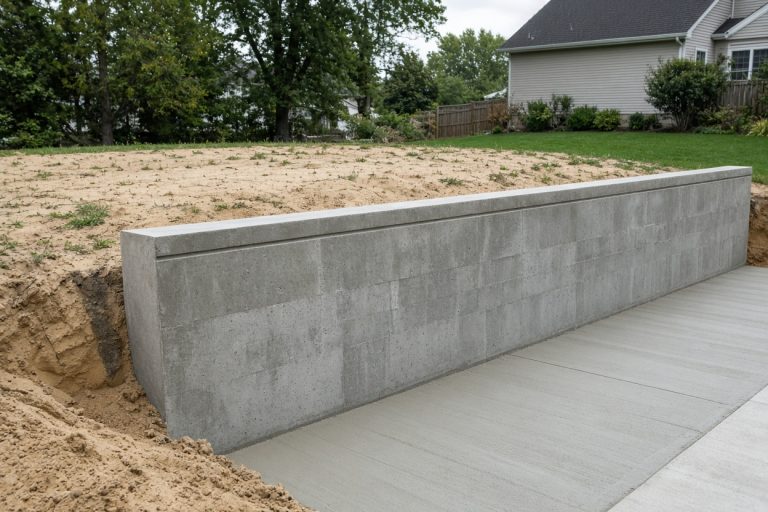
A concrete wall is what keeps that yard from slumping toward the house. We dig out the sand that has washed loose and set the footing below it. Then we form the wall and pour it. We backfill with stone so water can leave the bank. Water shouldn’t sit against the back of the wall. When the grade is steep, that drainage matters as much as the wall itself.
People also ask us to pull an old timber wall while we are there. The wood has usually rotted at the soil line, and the bank has started to bow. So the visit can cover more than the wall. Then we pour the new wall in residential concrete. We can add a service walk along the base. Or we reset a curb where the slope meets the drive. Retaining Walls in South Haven have gone in on lots where the bank and the drive edge were both moving. We measure both before we form the wall.
Get A FREE Proposal Today!
What We Look at for Retaining Walls in South Haven
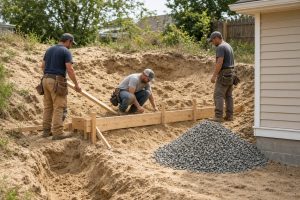
Before we pour, we walk the bank with the owner. After rain, we look at where water leaves the yard. We also check how close the slope sits to the foundation. Then we check whether an old wall is still doing any work. Sometimes the sand has already moved past it. For example, a bowed timber wall with soil spilling through the joints tells us the bank is already moving.
We’ve pulled up rotten ties on South Haven jobs and found the sand washed out behind them. People have called us after they thought the ties were holding. Then a wet spring opened a gap at the top. Retaining Walls in South Haven replace that failed wall when the bank still has to stay off the house.
Our crew has done this work since 2006, and Cabe’s Concrete is a family owned and operated company. So we source the concrete, and we know it is the best available for the wall. After that, we’ll work with you on the height and the finish. Read about the crew on About Us. The page for our concrete retaining walls also lists the other flatwork we pour. Finished walls from lots like these sit in the photo gallery.
When the wall is in, the sandy bank has a hard face between the yard and the house. We grade the top so water sheds toward the drains we set. We keep the pour line straight so the wall doesn’t trap a low spot. On some South Haven lots the same visit covers concrete removal of the old wall. We’ve poured a short upper walk when a side door needed a level path. We size Retaining Walls in South Haven from the bank we measure on that lot. Then we mark that height on the forms before the truck shows up.