
Dyer Indiana Concrete Equipment Pads – Side Yards
Folks often think a tilted condenser means the machine is too heavy for the yard. The unit does weigh a lot, and it sits in one spot for years. People call us about Concrete Equipment Pads in Dyer when an older pad has gone out of level. After a wet stretch, clay in these yards swells under the pad. It shrinks once the yard dries out. Then a thin slab or a plastic square follows that movement. The refrigerant lines at the unit pick up that lean.
Dyer yards often have tight clay a short way down, and that clay changes with the moisture. We’ve dug pad bases where the soil came up in sticky clumps. But gravel tossed on top of that clay still leaves a wet line under the stone. Water stays at the clay line under the stone. So one corner of a light pad drops a little more as the moisture changes.
Clay Movement Under Concrete Equipment Pads in Dyer
We’ve pulled up slabs that rocked when you stepped on the corner. The old pad was often a thin square sitting on a skim of gravel. Under that, the clay had a soft pocket on one side. Because the pad was thin, it cracked across the middle or tipped toward the downspout. Generator pads do the same thing. A standby unit vibrates every time it runs. Then a pad that is already low on one side works the soil a little more.
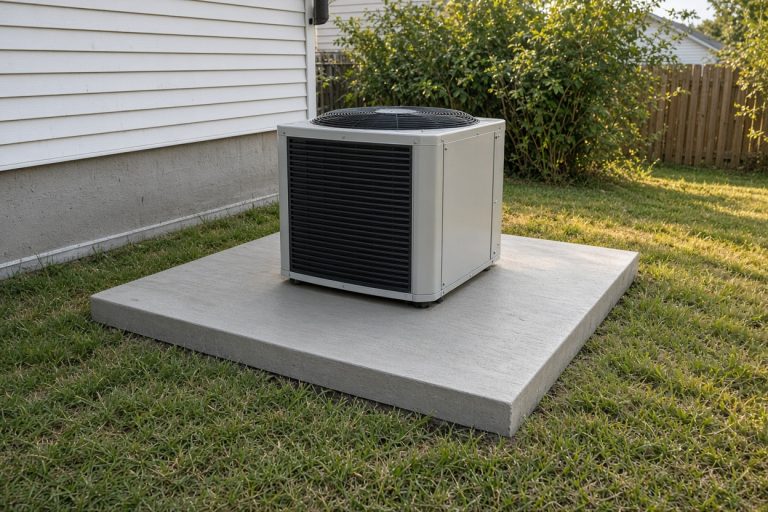
Air-conditioner and generator pads set on Dyer clay often tilt as the ground moves. So that tilt is what brings owners to a new poured pad. A precast block can look fine the day it goes in. After wet and dry weather, it follows the clay, and the unit goes with it. We form a pad wider than the condenser feet and thicker than the piece we take out. Our crew cuts out the soft clay and puts a compacted stone base under the new concrete. We compact that stone before the pour.
Get A FREE Proposal Today!
Replacing a Tilted Pad with Concrete Equipment Pads in Dyer
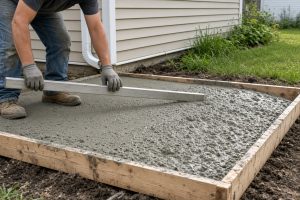
The job usually starts with concrete removal. We break out the old pad. Then we haul the pieces off. If the condenser has to come off the pad, an HVAC tech handles the disconnect and the set-back. We don’t move charged refrigerant lines. After the old concrete is gone, we dig out the soft clay and set forms for the new pad. Then we place and compact the stone. The pour comes after that.
On the same visit we can take care of other concrete next to the unit. For example, a cracked service walk or a short run that needs tear out and replace can share the schedule. We do residential concrete around the house. When a short walk has dropped the same way, we handle that concrete replacement too. Cabe’s Concrete is a family owned and operated company, and our doors opened back in 2006. Details sit on our About Us page.
People have called us for Concrete Equipment Pads in Dyer. Because the condenser had sat crooked, the lines took the stress. So we write the scope out line by line, with the tear-out and the pour both listed. That kind of pad is part of our concrete equipment pads work.
We’ve poured pads beside garages and along side walls in Dyer, Indiana. Those spots are tight. The mower still has to pass, and a downspout often dumps near the corner. So we keep the pad level for the unit. We shape the grade around the pad so water runs off the clay. When the forms come off, the condenser has a flat place to sit. We keep job photos of pads like that in the Photo Gallery.
Winter Frost Under Concrete Equipment Pads in Dyer
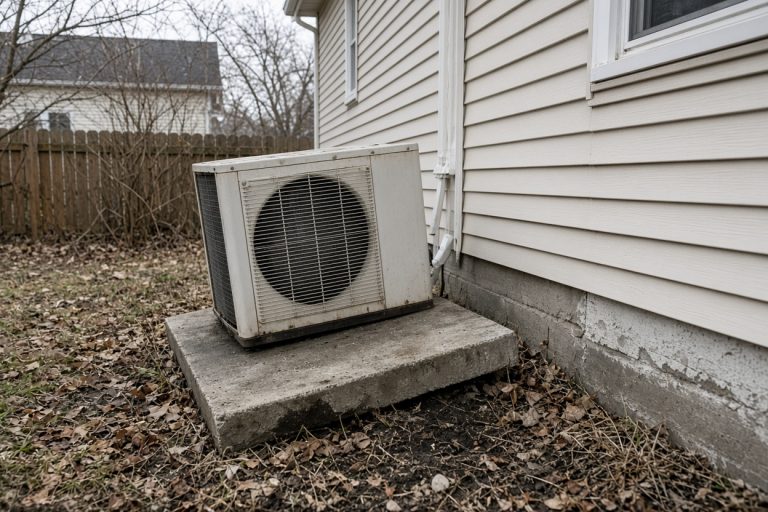
In winter, frost in the ground can lift a shallow pad. Then it may come back down uneven after the thaw. We’ve seen corners that stayed high once the ground softened.
Because of that, we put the base below the soft topsoil. We compact the stone in lifts when the hole needs the extra depth. An HVAC tech sets the condenser back after the concrete has hardened.