
Dyer Indiana Barn Concrete Slabs on larger lots
A lot of folks think a barn floor is just a patio poured bigger. We hear that on larger lots in Dyer. When they call, it’s usually an old shed or a new pole barn. A patio only has to hold foot traffic and a grill. Barn concrete slabs in Dyer have to hold a tractor and months of wet boots. So the thickness and the base both change.
We’ve pulled up patio-style slabs in equipment sheds that cracked under the rear tires. The concrete was thin. But the stone under it was soft. After a wet fall, the ground under the stone stayed soft and the slab rocked. People had asked for the same pour they saw on a neighbor’s back patio. We walk them through the tractor load before we set the shed floor thickness.
Load and winter wet on barn concrete slabs in Dyer
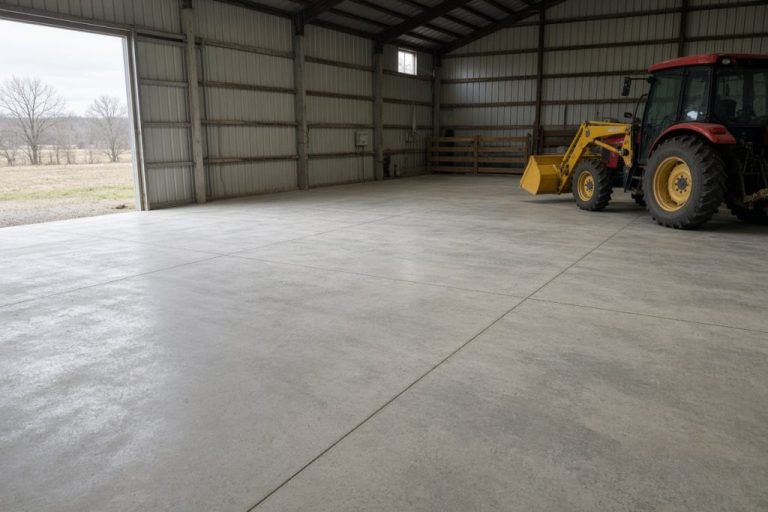
Dyer grew out of Lake County farmland into a suburb. Because bigger lots still keep a barn or shed behind the house, those buildings still need a working floor. The floors carry tractor weight and winter moisture. A patio crew never pours a house slab for that weight or that water.
Owners on these lots have told us they drive toward the Illinois line for work. But they still want room at home for a truck and a trailer. The shed holds the machines that get used every week. So the floor takes that roll-in, plus salt that drips off the tires after a salted road.
We size barn concrete slabs in Dyer for the machine that will sit on them. We don’t copy a patio job for this. So we ask what you park inside and how often it moves. Then we set the thickness and the stone base to that use. A four-inch patio spec is the wrong starting point. A tractor’s rear axle bears on a small patch of floor.
Standing water is the moisture problem we plan for. Snow comes in on the tires. Then rain blows through the open door. When the floor has no slope toward that door, water sits in the low spots until the next freeze. We’ve seen the surface scale where water stood all winter. So we pitch the slab toward the big opening. We also keep the edges from trapping melt water against the wall.
Get A FREE Proposal Today!
barn concrete slabs in Dyer for equipment sheds and pole barns
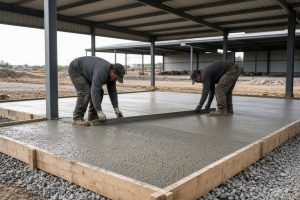
A barn floor starts in the ground. We strip the soft top and compact a stone base until it stops moving under the plate. Then we set forms that hold a straight edge at the door. After that we place the concrete and strike it off. We cut joints so cracks have a line to follow. For pole barns we also watch the post locations. The slab has to meet the building the way the builder drew it.
We place rebar or fiber where the tires travel. So the choice depends on the load you described. But a light mower shed can stay lighter in the steel. A tractor that lives inside needs steel in the wheel path. Exterior mix for these floors carries air so freeze and thaw do less to the surface paste.
Old floors are a different visit. When a slab has heaved at the door, we’ve torn the whole floor out. Concrete removal and a tear out and replace are part of that work when a patch won’t hold. We also pour new construction floors when the building is going up at the same time. For example, a service walk from the drive to the shed can go in on the same visit. So that gives you one clear path.
See our barn concrete slabs work for the wider flatwork we pour. Barn concrete slabs in Dyer sit in that same line of work.
Cabe’s Concrete is a family owned and operated company. Because we have worked across North West Indiana since 2006, barn floors are a regular job for us. The story of the crew is on our About Us page. Joint lines and door edges from finished sheds are in the Photo Gallery.
On a Dyer lot the apron outside the door matters too. Barn concrete slabs in Dyer should meet the gravel or the drive without a lip that catches a mower deck. Then we form that transition while the floor is still open. So the mower rolls off the slab onto the drive in one plane.
We tell you when foot traffic is fine and when the tractor can roll back in. Temperature changes that wait. So a cold Indiana week means the tractor stays out longer. A green slab will take a tire print if the tractor comes back early.