
Griffith Indiana Concrete Steps – Crumbling
You’re at the front door, deciding if a patch will last another winter. Concrete Steps in Griffith on older houses often scale after salt and freeze-thaw. A thin coat on soft concrete usually comes back off. So check how deep the break runs before you spend money on a skim coat.
A lot of the older houses we work on in Griffith have a short entry. Two or three risers, and a small landing at the door. Salt from the sidewalk sits on those treads through the cold months. After the thaw, the surface paste is pitted, and the nosing starts to round off.
We’ve torn out steps that looked only worn from the sidewalk. Under the face the concrete was soft. After we broke the face off, the mesh sat close to daylight. Because a piece let go on the bottom riser, people called us. Others called when the step shifted under a foot.
A sound step with a shallow flake can take a bonded patch. We tap the tread and listen for a solid hit. When the concrete sounds hollow, the patch has nothing solid under it. But a lot of the calls we get come after winter, and the step is already past a patch.
Concrete Steps in Griffith After We Pour a New Set
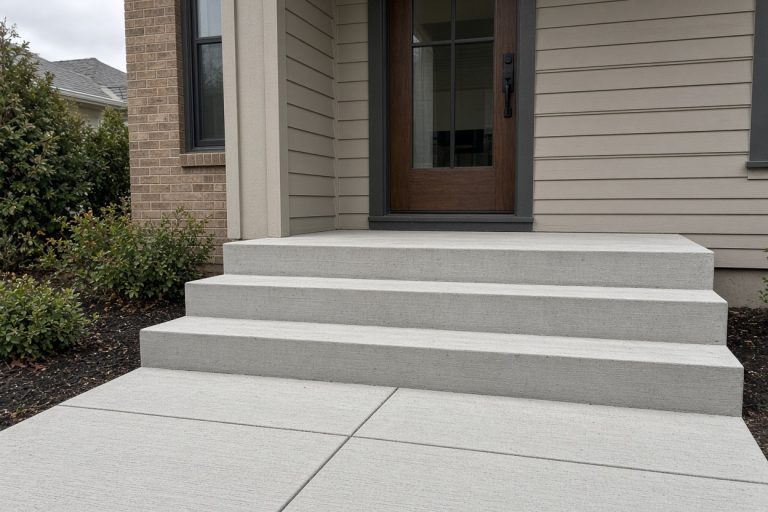
People have called us for a replacement once the damage was past a patch. We form each riser to the same height. We set the landing so the door still swings clear. Then we pour an air-entrained mix, because exterior steps in this climate need it. Griffith gets repeated freeze and thaw in a normal winter.
The finish is a light broom, so wet treads still have grip. You can look through our photo gallery to see finished entries like these. Older houses in Griffith often sit close to the front walk. So the new bottom step has to meet that grade without a raised lip.
Get A FREE Proposal Today!
Salt Damage on Concrete Steps in Griffith
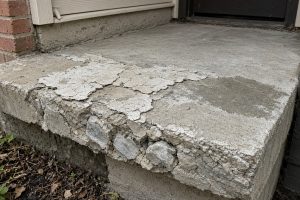
Water gets into the small cracks and the open pores on a step face. When that water freezes, it expands and pops the surface. Then it thaws, and more water gets in. Salt keeps the surface wet at colder temperatures, where plain water would have stayed frozen. So one cold season can push Concrete Steps in Griffith through extra freeze-thaw cycles.
After we remove older steps, we often see a soft, sandy face. The stone shows through on the nosing. A patch can hold when the break is shallow and the step is still solid. When the nosing is gone and the tread rocks, the whole step comes out. We’ve found hollow spots under treads that still looked flat from the walk.
Because meltwater and salt sit longest on the bottom riser, that is where we find the deepest scale. So the bottom step is the one we check first.
Forms and Pour for Concrete Steps in Griffith
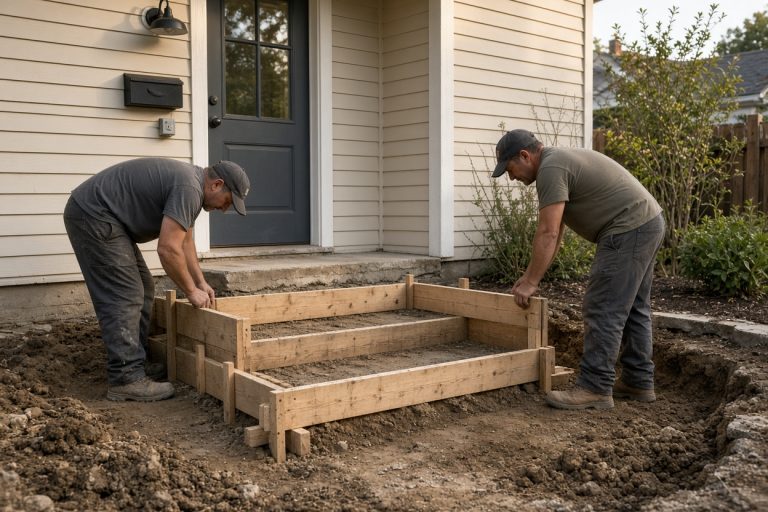
We break the old concrete out and haul it off. Then we set forms off the foundation and out to the walk. The new pour has to pitch water away from the house. For example, meltwater runs at the threshold if the landing tips back. We fix that slope before the concrete goes in.
On the same visit we often take care of the service walk, if it has the same salt damage. So concrete removal on that walk, or a tear out and replace, fits with the step job. You can see how that sits with our concrete steps work and the other residential concrete we pour. When the upper walk from the drive is breaking up, we can replace that too.
We pour Concrete Steps in Griffith for houses that still have the original stoop. Cabe’s Concrete is family owned, and we’ve been pouring since 2006. The About Us page says more about the crew. Before we build the forms, we talk through landing size and riser count. Our mix for exterior steps is one we have used on these jobs for years. And we keep the entry closed only as long as the pour needs.
We tool the joint where the new landing meets the foundation, so water has a path off the step. The broom lines run across the tread. After the forms come off, the entry is a plain set of steps sized to the old opening. So we measure that gap before we set the pour. On the Griffith fronts we have worked, the sidewalk often sits close to the door.