
Highland Indiana Concrete Curbs for Flat Streets
Highland sits on flat ground in the Calumet part of Lake County. The old lake plain doesn’t give a street much fall. So rain has to travel along the curb to reach a storm inlet. Concrete Curbs in Highland do that job on block after block of residential street. While the face is whole, water stays in the gutter pan and moves toward the inlet. Then a missing chunk opens a gap, and water spills out and sits.
We’ve walked these streets after a hard rain and seen the same pattern. But the pavement looks dry a few houses down. Then a low spot at a broken curb holds a puddle against the grass. Because the grade is slight, that puddle doesn’t find its own way to the inlet. So it needs the curb face to steer it.
Homeowners have asked us about Concrete Curbs in Highland when a puddle reaches the sidewalk. They usually point at a missing chunk of face and a dark stain in the grass.
How Concrete Curbs in Highland Move Rain to the Inlet
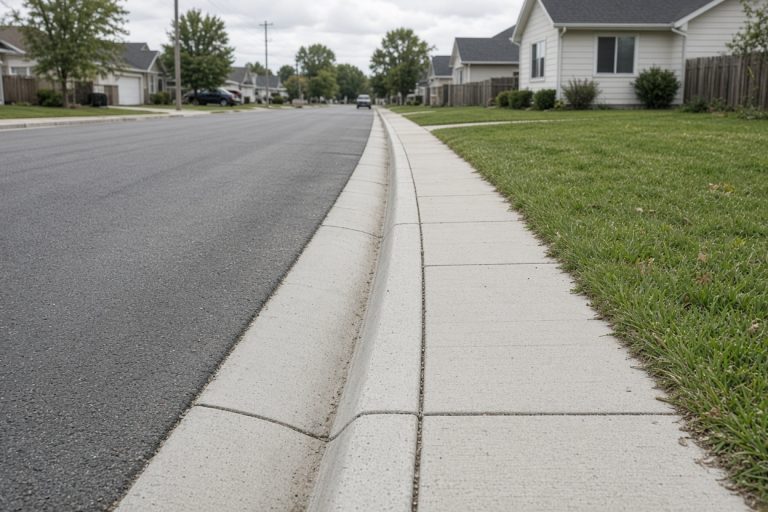
A curb and gutter is a small channel at the edge of the pavement. The face stands above the pan. The pan slopes toward that face. So sheet flow off the street hits the face and turns down the block. Highland streets have little fall from one end of a block to the other. So the gutter has to carry the water.
We set the forms so the new gutter matches the old flow line. Then we check the inlet end before we pour, because a high pan stops water short of the grate. But a low spot in the wrong place ponds water at the driveway. After the concrete sets, we run a hose along the pan and watch where it goes.
For example, driveway curb cuts are where we see the worst breaks. Tires drop off a chipped face, and the pan takes the hit. Because that spot is where rain leaves the gutter, a broken cut sends water onto the apron first.
Winter in Northwest Indiana puts salt on the pavement. Salt and freeze-thaw wear the top of a curb face. So water gets into a small crack. Then it freezes and the face pops off in a plate. We’ve chipped out curb that looked solid from the street and was hollow under the surface. After that, plow blades catch a high spot and take another piece. We often find the gutter pan cracked and the flow line gone after winters of salt and plows.
Get A FREE Proposal Today!
Replacing Concrete Curbs in Highland After the Face Breaks
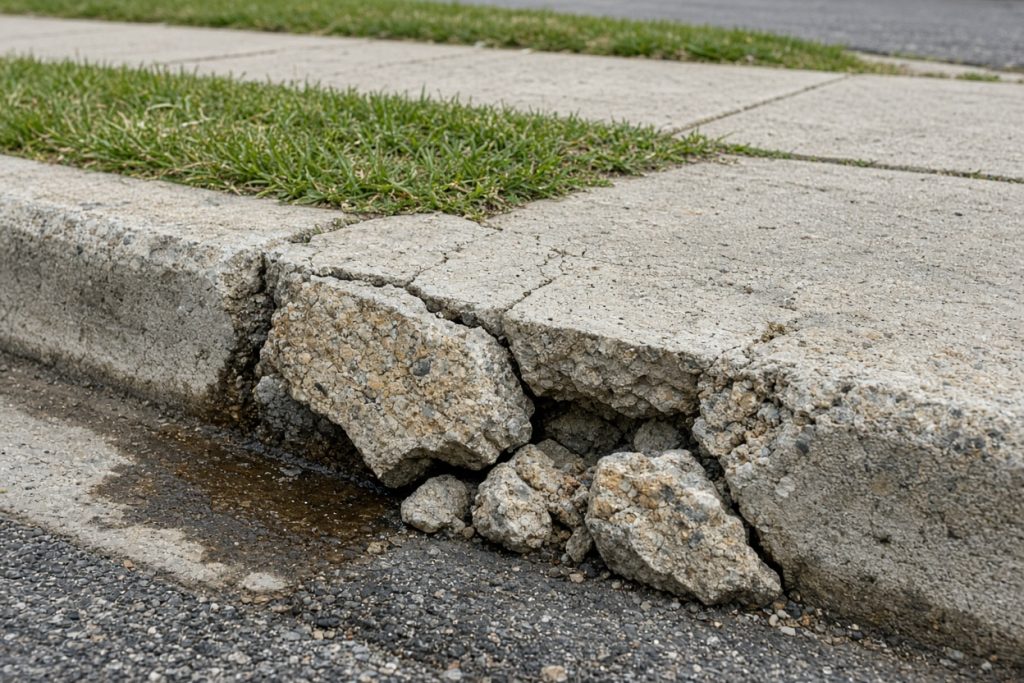
On Highland’s flat streets, curb and gutter is what carries rain to the storm inlet. So a crumbled curb is a drainage repair a concrete crew is called to pour. After rain, people have called us when the driveway curb was gone and water sat on the apron. We’ve pulled up those sections and poured them back to the old flow line.
The work starts with a saw cut at sound concrete. Then we break out the bad curb and gutter and haul the pieces off. Because some blocks need a full tear out and replace. We remove only the broken run when the rest of the curb is sound. We form the face and the pan and tie into the existing curb before we pour. For Concrete Curbs in Highland, that pour has to pick up the old slope. If it doesn’t, the inlet never sees the water.
When we find a broken service walk at the same joint, we replace it in the same visit. We also replace residential concrete at the apron when the apron has failed. Then the new face lines up with the old walk. Our concrete curbs work covers the saw cut through the finish on that run.
We’ve formed Concrete Curbs in Highland to meet an existing inlet and a driveway cut in one run. Then we tool the joint at the old curb so the two pours don’t lock and crack.
Our About Us page covers our family owned and operated company. Our doors opened back in 2006. The Photo Gallery shows finished curb faces.
We look down the face for a straight line before the forms come off. The gutter pan should line up with the inlet grate. After the forms come off, we check that the pan still falls toward the inlet.