
What Belongs Under the Floor: Commercial Concrete in Wheeler, Indiana
People bring up the floor after the walls and the doors are settled. By then the slab is already carrying tractors. A Wheeler equipment barn also holds wagons and implements through the winter. Commercial Concrete in Wheeler has to carry that weight day after day.
We’ve pulled up shop floors that started as a thin residential pour. After we pull the equipment out, the cracks show from the overhead door to the middle of the bay. When a loader turns, the tires grind the edge of those cracks. Then the pieces rock under the next pass. So the floor gets worse every season the equipment stays inside.
Wheeler farm shops sit in northwest Indiana. Winters here freeze and thaw, and water that sits in a crack expands when it freezes. So we see surface scale where meltwater and road salt ride in on the tires. After a few winters the top of a thin slab looks pitted even if the base still feels solid. A jack stand puts all its weight on a small spot. A full grain cart does the same on the slab.
What Commercial Concrete in Wheeler Needs Under Farm Equipment
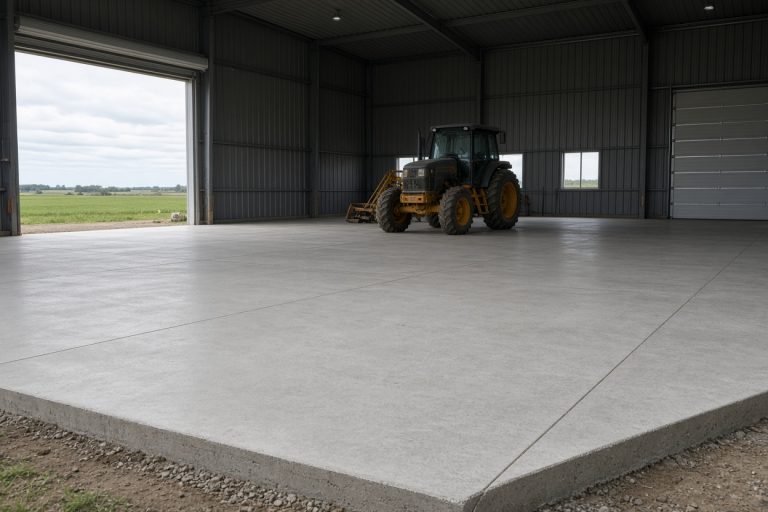
The base matters as much as the concrete. We strip the soft topsoil and put down compacted stone before any mud goes in. We compact the stone in lifts so the base doesn’t settle under a loaded tire. Then we set the thickness for equipment. Steel or fiber in the mix helps hold a crack tight if one starts. Control joints go where a crack is likely, in straight lines we can live with. For example, we line a joint up with a column or a door track. Then a random crack doesn’t run under the workbench.
A tractor and a loaded wagon will crack a light residential pour. So we build a Wheeler farm shop floor with the base and thickness we use on warehouse slabs. Commercial Concrete in Wheeler is the right class of work for that bay. The loads match a commercial floor.
Drainage at the door is part of the same job. When the apron outside pitches back toward the building, meltwater runs in and sits. We pitch the exterior flat work away from the threshold. On that visit we can also pour a service walk along the side of the barn. We replace a broken curb at the drive on the same trip. We set the curb so a mower deck clears it.
Get A FREE Proposal Today!
Building Commercial Concrete in Wheeler for a Working Shop
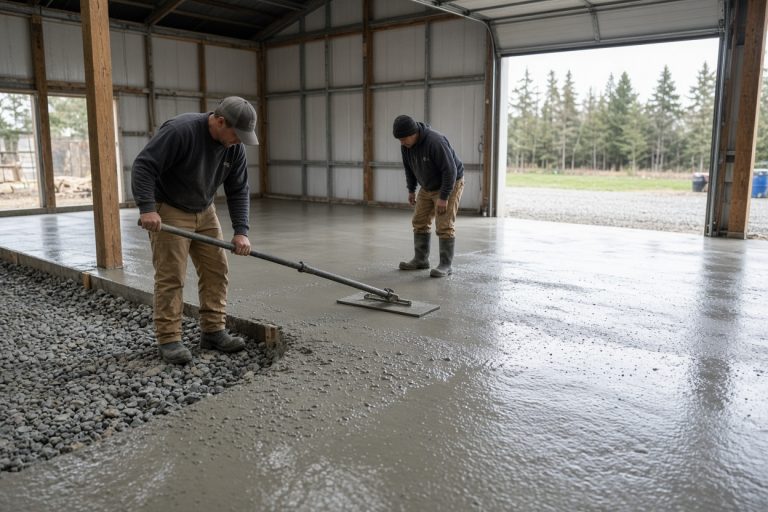
We form the bay and check the pitch before the truck is on the road. After the base is tight, we pour. Then we finish the surface for the use it will get. A shop that sees chains and loader buckets needs a hard steel-trowel finish. Because oil drips and manure both end up on the floor, some owners ask us to epoxy it.
Old floors come to us in pieces. We’ve sawed out a bad section and trench-cut along a crack before we poured it back. When the whole floor rocks underfoot, a tear-out and replace is the cleaner path. Then the new slab can be one plane, with joints we placed on purpose. Concrete repair still fits a spall at a door edge or a corner chipped by a plow. We say which one fits after we are on the floor.
Commercial Concrete in Wheeler covers equipment barns and pole barn slabs. Warehouse floors get the same approach when the loads match. Our page on commercial concrete for shops and barns shows similar loaded floors.
We’ve poured shop floors in this part of northwest Indiana since our doors opened in 2006. Our family owns and operates Cabe’s Concrete. So we write the quote out line by line. We list the stone and the hours on it. We don’t mark up the concrete to pad the bill. When our bid runs higher, we’ve usually counted more hours for the tear-out and the finish. Commercial Concrete in Wheeler can include the apron outside the door in the same visit. We work seven days a week across northwest Indiana and the Tri-State area. Our About Us page covers the company background. The Photo Gallery holds finished concrete from jobs around here. The cure time still depends on the weather and the mix.