
St. John Indiana Concrete Equipment Pads for Winter
You have a tilted condenser pad and a decision to make before the next hard freeze. Concrete Equipment Pads in St. John sit under condensers and standby generators beside the house. So a rocking pad won’t hold the unit level. When the pad tips, the condenser sits out of level all season.
A lot of houses in St. John, Indiana put the condenser on a small side-yard pad. When a house has a generator, it often sits closer to the garage. Because those pads are small and the ground stays wet, they move first in a freeze. So we’ve pulled pads that rocked under a boot. And we’ve seen units shimmed with scraps of wood.
Homeowners have asked if the old pad can stay for another winter. We have told people to pull the pad when the base is soft. We pour the new pad on packed stone. For a standby generator, we lean toward replacement sooner. Because that unit is heavy, and it shakes when it runs. A condenser pad can sometimes wait if it’s still solid and only a little off level.
Concrete Equipment Pads in St. John Through a Hard Freeze
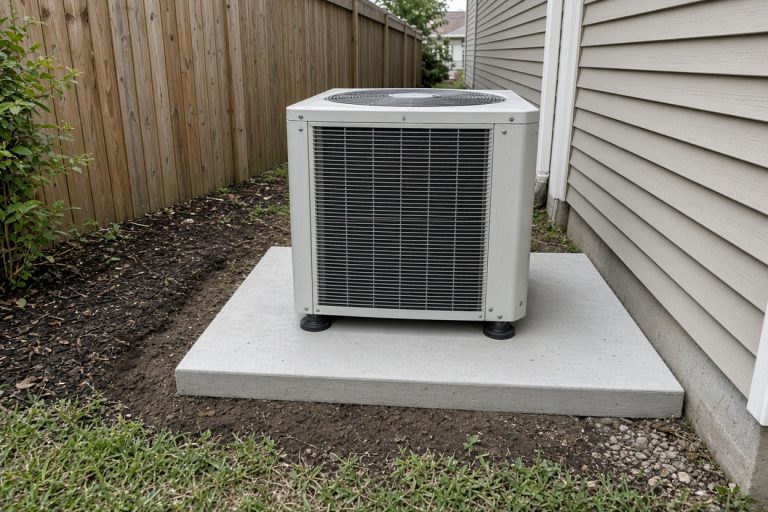
Water in the soil under a thin pad freezes and expands. That expansion can lift one edge. Then the thaw lets the edge drop, often into a low spot. After a few cycles the condenser no longer sits flat. We also see hairline cracks at the corners on pads poured too thin.
Downspouts often land next to the condenser in these side yards. The pad sits in that wet spot. So we compact a stone base under the concrete before we finish the top. Homeowners have called us about Concrete Equipment Pads in St. John after a pad heaved and the unit rocked. After we dug those out, we found mud where the stone should have been.
People have asked us to reset the unit and leave the old pad. But a pad that has lost its base will move again the next freeze. We’ve come back to yards where the shim was still there and the corner had dropped further. So we check the support under the pad on that visit.
Get A FREE Proposal Today!
How We Build Concrete Equipment Pads in St. John
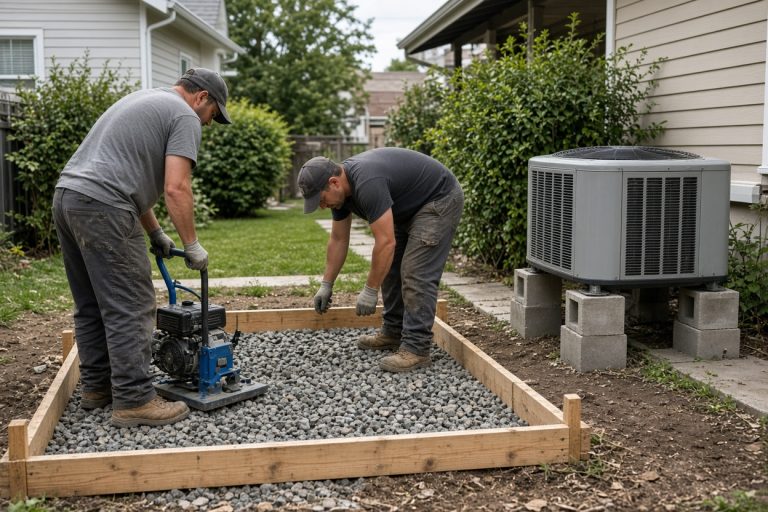
When we replace a heaved pad, we lift the unit clear and pull the old concrete. The soft soil under it comes out with the slab. Then we put down stone and compact it before any new concrete goes in. For a condenser, we size Concrete Equipment Pads in St. John to the unit with room past the feet. A standby generator needs a larger pad, because the weight and the vibration are higher.
We form Concrete Equipment Pads in St. John so the top sheds water away from the house. Because a low spot holds meltwater against the unit, we pitch the surface a little. After the concrete can take the weight, we set the unit back and check every foot. A high corner will rock the cabinet once we set it down.
People ask if a shim will get the unit through winter. But a wood shim under one corner leaves the pad free to move the next time the soil freezes. For example, wet wood swells and then crushes under the cabinet. We check the feet, and we want all of them touching with no scrap wood underneath.
The same visit can cover a heaved service walk next to the pad. We tear that walk out and replace it when both pieces failed the same way. That walk is residential concrete on the same house. You can see pads and small slabs beside houses in our photo gallery. Our concrete equipment pads work covers the pour and the base under the unit. Our about us page covers the crew, and we’re family owned and have poured since 2006. Concrete removal of the old pad comes first, then the new pour.