
Hammond Indiana Concrete Equipment Pads – Clay Soil
You notice it on a walk around the house. One corner of the pad sits higher than the other. A gap shows under the low side, and after a rain that gap holds a thin pool. Concrete Equipment Pads in Hammond take this lean when the soil under them moves. The condenser leans with the pad. Then the line set pulls a little at the wall.
After the unit starts to rock, people call us. The pad looked level the year it went in. A few winters later you can tip the high corner with your foot. Because the yard is flat, water doesn’t run off fast. So the ground under a thin pad stays soft for days.
We have pulled up pads in Hammond that were thin and set straight on the grass. No stone sat under them. The concrete was still hard when it came up. The clay under it had shifted, deeper on the down side. When we checked those pads with a straightedge, we could feel the rock.
A finished pad from Concrete Equipment Pads in Hammond
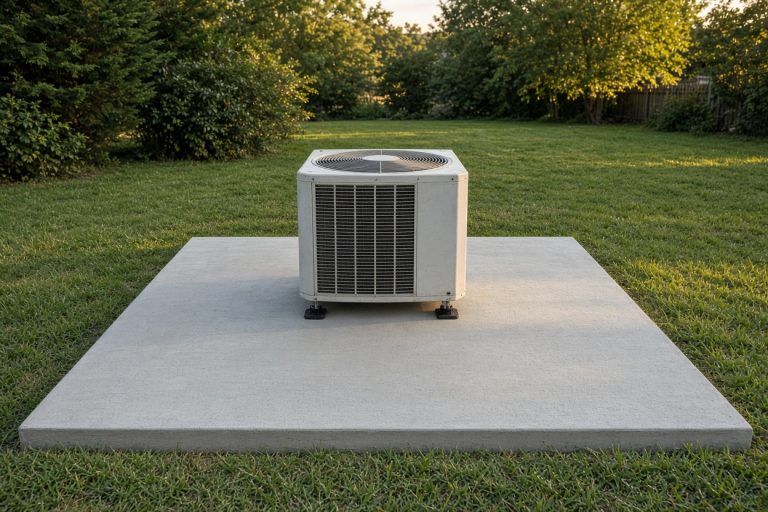
A sound pad spreads the weight of the unit across a flat top. So we set it a little above the grass, and splash doesn’t pond on the concrete through the winter. The unit’s feet land fully on the surface. After the forms come off, a push on a corner shouldn’t rock the pad.
We pour these for condensers and for generators. Because the set is heavier and it vibrates, a generator pad is larger. For example, we size each pad to the unit on that job. We measure on site when the homeowner doesn’t have the unit’s measurements.
Get A FREE Proposal Today!
Concrete Equipment Pads in Hammond on wet lake-bed clay
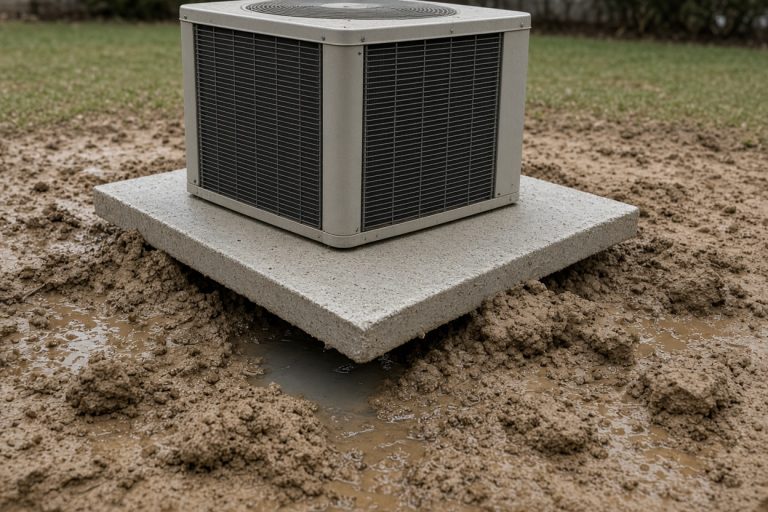
Hammond, Indiana sits on flat, wet ground that used to be lake bed. The clay holds water. When winter runs through freeze and thaw, that water turns to ice and lifts a thin pad. Then the thaw comes, the clay softens, and the low side drops. So Concrete Equipment Pads in Hammond tilt unless they sit on a solid concrete base.
We see this on older Hammond lots where the yard is still close to the old grade. The grass looks even from the side yard. Under it the clay is soft when a shovel goes in. After a wet fall, that softness shows up as a pad that rocks under the condenser.
A stone layer under the concrete gives water a place to drain. It also gives the pad a firm place to bear. We dig out the soft top and compact stone in its place before the forms go in. Because wet clay swells and dry clay shrinks, a pad on bare ground moves with that clay. So Concrete Equipment Pads in Hammond need enough thickness to stay one solid piece on the stone.
Pouring Concrete Equipment Pads in Hammond for outdoor units
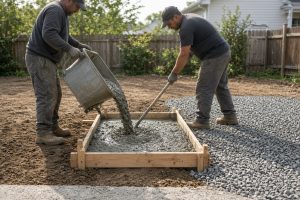
If the old pad is cracked or badly tipped, we take it out first. That work is concrete removal. On a small pad it is often a tear out and replace in one visit. We keep the unit’s lines clear of the pour. Or we pour after the installer moves the unit off the old pad. Then we set the forms on the stone and pour.
We are a family owned company, and we’ve poured concrete here since 2006. Our crew finishes small pads the same way they finish other residential concrete. Then they pull a straight edge and leave a surface that sheds water. We source the mix so we know what is in the truck. We write the quote out line by line before we start. So you can see the pad and the removal as separate lines.
You can read about the family company on our About Us page. For example, the photo gallery shows finished pours, including pads.
Pads are part of our concrete equipment pads work. They sit next to the slabs and walks we pour on these lots.
On some Hammond houses the same visit can cover a short service walk. We only add that walk when you ask for it. But we list a walk as its own line, because it needs its own forms.
Clay in Hammond stays wet in spring and freezes hard in winter. So a condenser or a generator still needs a level pad under it. We form that pad to the footprint of the unit. We pour it on compacted stone. The top stays level, because the condenser needs to sit level. Then we rake the loose soil back around the edges. When the yard in Hammond is flat, water sits against a pad flush with the grass. We hold the pad a little above that grade so the edge stays drier.